


Dear CC Residents

Dear Clinton County Residents,
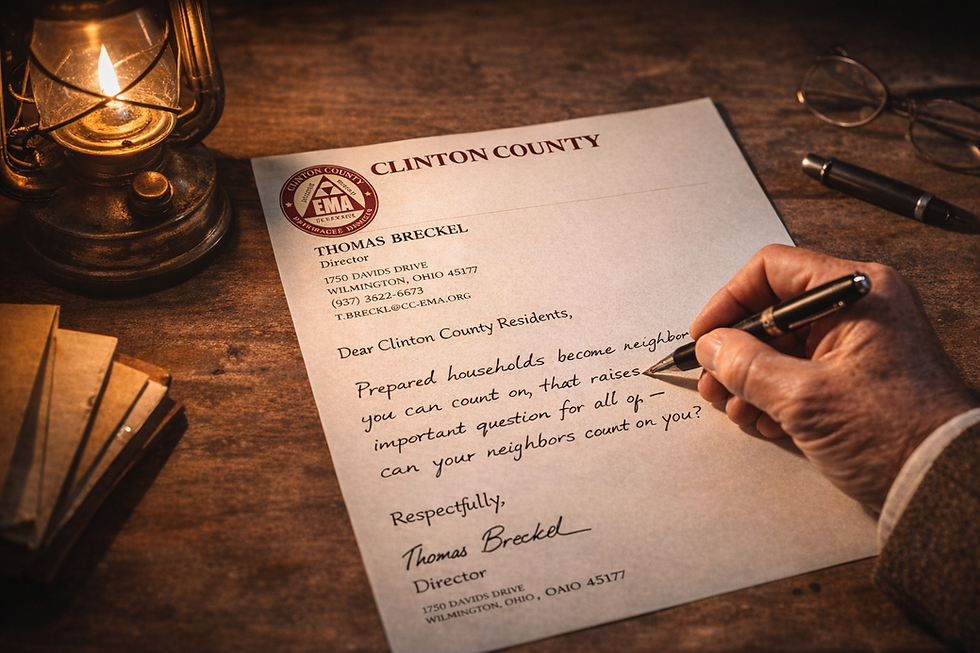
As we look ahead to 2026, many people are thinking about resolutions—changes they hope to make and priorities they want to set for the year ahead. I encourage you to consider one resolution that strengthens not only your household, but our entire community: making your household prepared. Prepared households become neighbors you can count on, and that raises an important question for all of us—can your neighbors count on you?
Household preparedness does not begin with equipment or supplies. It begins with a conversation. Taking time as a family to talk through the types of emergencies that could realistically affect your household over the coming year sets the foundation for everything else. In Clinton County, natural hazards such as tornadoes, severe thunderstorms, straight-line winds, winter storms, extreme cold, heat waves, localized flooding, and the associated prolonged power outages are part of our reality. Talking about these risks helps move preparedness from an abstract idea into a practical plan that everyone in the household understands.
That same conversation should include technological hazards that can disrupt daily life with little warning. Rail incidents, roadway crashes involving hazardous materials, aircraft emergencies, pipelines that transit the county, house fires, infrastructure failures, and extended power outages all present challenges that families should think through ahead of time. Acknowledging these possibilities allows households to discuss what they would do, where they would go, and how they would communicate if normal routines were interrupted.
Manmade hazards also deserve attention. Hazardous material spills that may require sheltering or evacuation, cyber incidents or ransomware that affect banking or communications, civil unrest, and crime all influence how a household should prepare. These discussions are not meant to create fear, but clarity. Families should talk honestly about where they would shelter and where they would not, what actions make sense and which do not, what items they would take with them, and what should be left behind. These conversations form the basis of a household emergency plan—one that may change with the season or the situation. Additional planning guidance, evacuation information, and details on local hazards are available at https://www.cc-ema.org/plan, https://www.cc-ema.org/evacuation, and https://www.cc-ema.org/hazards.
Once a plan begins to take shape, the next step is building emergency kits that support those decisions. Preparedness is not one-size-fits-all, because hazards are not one-size-fits-all. The supplies you rely on while sheltering during and after a tornado are very different from what you would need if you had to leave your home quickly due to a hazardous materials incident. A practical place to start is preparing to be self-sufficient for three days without outside assistance. Over time, those supplies can be expanded to support your household for 30 days or more. It is important to remember that preparedness is not a single bag or tub of supplies, but a range of items staged in different ways to give your household options. Guidance on emergency kits, financial preparedness, and planning for pets can be found at https://www.cc-ema.org/kit, https://www.cc-ema.org/financial, and https://www.cc-ema.org/pets.
Understanding alerts and warnings is another key part of preparedness. Knowing when to take action, when to wait, and when to seek more information allows households to respond deliberately instead of reacting out of uncertainty. Learning how alerts are delivered and what they mean is an important step in protecting your household. More information on local alerting systems is available at https://www.cc-ema.org/alerts.
Prepared households become neighbors you can count on, and that raises an important question for all of us—can your neighbors count on you?
When a household is prepared and does not immediately need help, it strengthens the entire community. Households that are ready are more likely to check on neighbors, share information, or offer assistance when it is safe to do so. This reduces the demand on our limited first responders and allows emergency services to focus on those who need immediate help. Prepared households become neighbors you can count on—so I ask again, can your neighbors count on you?
Preparedness does not have to stop at your front door. I encourage residents to consider becoming involved with local organizations that support disaster response and recovery. A Volunteer Organizations Active in Disaster (VOAD) open house will be held on Thursday, January 22, 2026, from 6:00 p.m. to 8:00 p.m. at the Clinton County Administrative Campus, 1850 Davids Drive, Wilmington, Ohio 45177. This free event is an opportunity to learn about organizations active in our area, explore training opportunities, and find ways to contribute to a stronger, more resilient county.
As we move into 2026, I encourage you to make preparedness a resolution that truly matters. Start the conversation, build the plan, strengthen your household, and connect with your community. Our county is strongest when neighbors can count on one another.
Respectfully,
Your Friends & Family at Clinton County EMA


Excellent communication, connections and care, Tom . Thank you. We'll be a good neighbor, and will see you the 22nd.